
NHS vs Private Healthcare Decision Tool
Complete the form to receive a personalized recommendation based on your priorities and circumstances.
Imagine you’ve been paying for private health insurance in the UK because you needed a quick operation or wanted to avoid long waits. Now, your situation has changed. Maybe your contract ended, premiums got too high, or you simply feel ready to rely on the public system again. The question on everyone’s mind is simple: can you just go back?
The short answer is yes. You can absolutely return to the National Health Service (NHS) at any time. There is no penalty, no waiting period, and no bureaucratic hurdle stopping you from using your NHS number again. Your right to free-at-the-point-of-use healthcare does not expire just because you chose to pay for something else temporarily.
Your Right to NHS Care Never Expires
It helps to understand how the NHS works under the hood. The NHS is funded through general taxation and National Insurance contributions. It is not an opt-in scheme like a gym membership or a streaming service. As long as you are ordinarily resident in the UK, you are entitled to use its services.
When you buy private medical insurance (PMI), you are essentially buying a parallel track. You step out of the standard queue for specific treatments, but you never leave the system entirely. In fact, many private procedures still happen in NHS hospitals during off-hours, or involve NHS consultants who split their time between the two sectors. This means your medical history often remains linked across both systems, depending on how data is shared.
So, if you decide to cancel your private policy today, your access to GP appointments, A&E visits, and routine care starts immediately. You don’t need to re-register with the NHS. You just walk into your local clinic like you did before.
Why People Choose to Return to the NHS
People switch back to the NHS for various reasons. Understanding these motivations can help you decide if it’s the right move for you.
- Cost Savings: Premiums for comprehensive policies can range from £100 to over £300 per month. If you haven’t used your cover recently, that money adds up fast.
- Job Changes: Many people get private cover through their employer. When they change jobs, they might lose that subsidized rate and find the individual market too expensive.
- Pre-existing Conditions Managed: Perhaps you had private care for a specific issue-like a knee replacement-and now you’re healthy. You might feel the risk is lower and want to save cash.
- Simplicity: Dealing with claims, excess payments, and pre-authorizations can be stressful. The NHS removes that administrative burden.
The Reality of Waiting Times
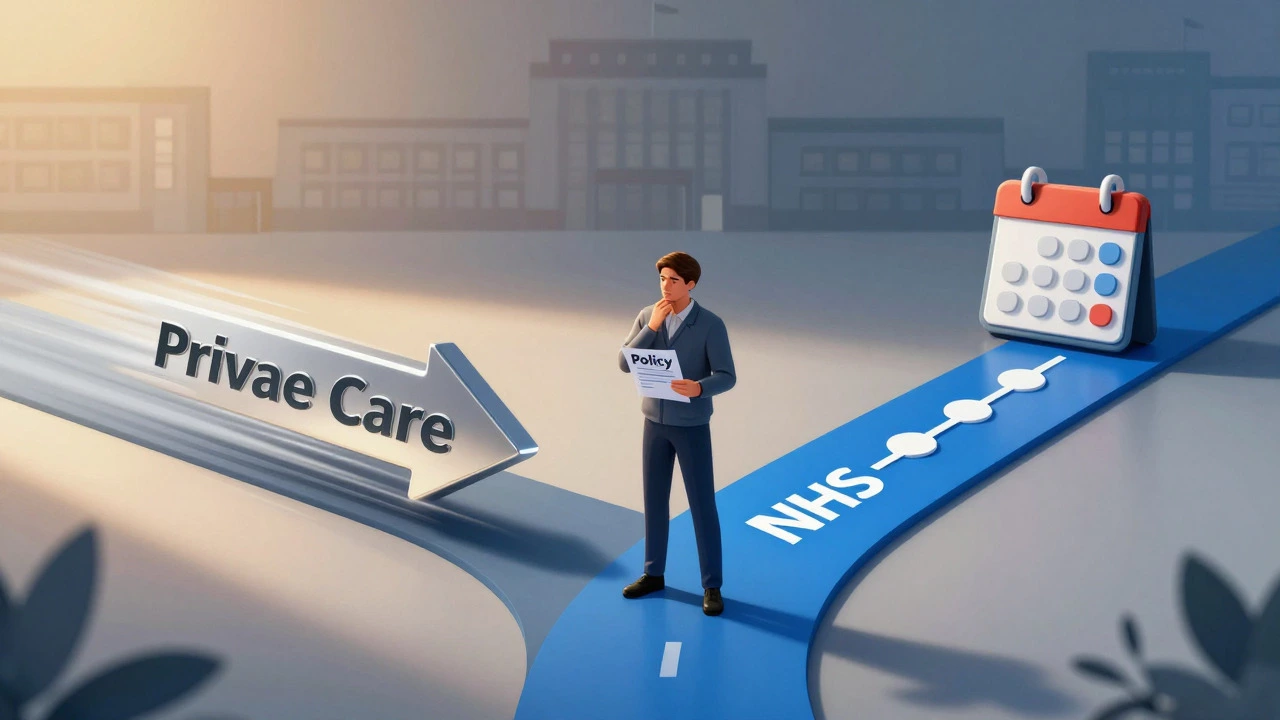
This is the big elephant in the room. Before you cancel, you need to look at the current state of NHS waiting lists. As of 2026, the NHS is still working through significant backlogs accumulated during the pandemic years. While emergency care remains swift, elective surgeries and specialist referrals can take months.
If you have a non-urgent condition, such as a hernia repair or cataract surgery, you might face a wait of six to twelve months. In contrast, private care could offer that same procedure within weeks. Ask yourself: can you afford to wait? If the answer is yes, returning to the NHS makes financial sense. If you have a painful or limiting condition that needs immediate attention, staying private-or keeping a limited policy-might be worth the cost.
Keep in mind that "waiting" doesn’t mean "ignoring." Your GP will still see you promptly. They can prescribe pain management, physiotherapy, or other interim treatments while you sit on the referral list. The delay usually applies only to the actual surgical intervention or specialist scan.
How to Cancel Your Private Policy Correctly
Cancelling isn’t always as simple as sending one email. You need to follow the correct steps to ensure you aren’t charged for another month unnecessarily and to handle any outstanding claims.
- Check Your Notice Period: Most insurers require 30 days’ written notice. Check your policy document for the exact clause. Some newer digital-first insurers allow instant cancellation via an app.
- Notify Your Broker: If you bought your policy through a broker, tell them first. They can confirm the process and ensure your paperwork is filed correctly.
- Settle Outstanding Claims: If you have a claim currently being processed, ask if you should keep the policy active until it’s resolved. Cancelling mid-claim can sometimes complicate reimbursement.
- Get Confirmation in Writing: Don’t rely on a phone call. Get an email or letter confirming your end date and any final refund due.
Impact on Pre-existing Conditions
Here is a crucial point that catches many people off guard. When you are on private insurance, your conditions are covered according to your policy terms. But when you return to the NHS, those conditions become part of your standard medical record.
If you later develop a new health issue, the NHS treats it based on clinical need, not your insurance history. However, if you ever want to buy private insurance again in the future, this gap matters. Insurers will ask about all past conditions. If you had a heart condition treated privately five years ago, and then went back to the NHS, that heart condition is still "pre-existing" if you try to buy new private cover ten years later.
In other words, going back to the NHS doesn’t "reset" your medical history for future private applications. It just changes where you get treated today.
Hybrid Approaches: Keeping Some Cover
You don’t have to choose between full private cover and nothing. Many people opt for a middle ground.
| Option | Best For | Cost Estimate | Risk Level |
|---|---|---|---|
| Full Private Policy | Major surgery, cancer coverage, peace of mind | £150-£400/month | Low |
| Limited/Excess Policy | Minor issues, diagnostics, avoiding small bills | £50-£100/month | Medium |
| No Private Cover | Healthy individuals, tight budgets | £0/month | High (wait times) |
A "limited" policy might exclude major surgeries like hip replacements but cover things like MRI scans, physiotherapy, or minor outpatient procedures. This allows you to bypass some NHS bottlenecks for diagnostics without paying for full hospitalization cover. It’s a smart way to manage costs while retaining some control over your care timeline.
What Happens to Your Medical Records?
Your health data follows you. Private hospitals and clinics are required to share information with your NHS GP upon request. This ensures continuity of care. If you had surgery privately, your GP should have a copy of the discharge summary. If they don’t, ask for it. Having complete records is vital if you need further treatment on the NHS later.
Conversely, if you receive treatment on the NHS after being private, that data stays in the NHS Spine (the national electronic health record). Future private insurers will have access to this if you apply for cover again. Transparency is key; never hide past treatments, whether public or private.
Special Cases: Dentistry and Optometry
Remember that private health insurance rarely covers dental work or eye tests unless you add specific riders. These services remain largely separate from main medical policies. Returning to the NHS for medical care doesn’t change your status for NHS dentists or opticians. You still pay the standard NHS charges for these services, regardless of your medical insurance status.
Finding an NHS dentist can be challenging in many parts of the UK due to capacity constraints. If dental care is a priority, consider keeping a separate dental plan or looking for private dentists who offer fixed-price packages, independent of your medical insurance.
Will I have to wait longer for an appointment if I cancel my private insurance?
Yes, likely. For non-emergency treatments like joint replacements or cataract surgery, NHS waiting times can range from several months to over a year, depending on your region and urgency. Emergency care (A&E) remains immediate, and GP appointments are usually available within a few days.
Does cancelling private insurance affect my future ability to get cover?
It can. If you cancel and then try to buy private insurance again later, you will be assessed based on your health at that new time. Any conditions developed or diagnosed while you were back on the NHS will be considered pre-existing. Gaps in coverage can lead to higher premiums or exclusions.
Do I need to inform the NHS that I am cancelling my private policy?
No. The NHS does not need to know about your private insurance status. Your entitlement to NHS care is based on residency, not insurance. Simply update your GP if you wish to note that you are no longer seeking private referrals, but it is not mandatory.
Can I keep my private insurance for just emergencies?
Most standard private policies cover both planned and emergency treatment. However, you can look for "acute-only" or limited policies that focus on unexpected illnesses rather than scheduled surgeries. These are cheaper but may not cover chronic conditions or elective procedures.
Is there a penalty for cancelling private health insurance early?
Generally, no. You typically pay for the month you cancel in, plus any notice period fees if applicable. There are rarely heavy exit penalties, but check your specific contract for "short-term rating" clauses if you cancelled very quickly after starting.