
EMTALA Emergency Care Eligibility Checker
This tool helps you determine if your symptoms qualify for emergency medical care under US federal law (EMTALA). Based on the article content, hospitals are required to screen and stabilize emergencies regardless of insurance or ability to pay.
Every year, over 140 million people visit US emergency rooms. Some walk in with broken bones. Others come with chest pain, severe infections, or childbirth. But what happens if you show up without insurance, money, or even a Social Security number? Can a hospital legally turn you away? The short answer: no-not in an emergency. But the reality is far more complicated.
EMTALA: The Law That Stops Hospitals From Saying No
In 1986, Congress passed the Emergency Medical Treatment and Active Labor Act, or EMTALA. It’s not a well-known law, but it’s one of the most powerful protections for patients in the US. EMTALA says that if you walk into any hospital that accepts Medicare-which covers nearly all US hospitals-you must be given a medical screening exam. No questions asked. No payment required upfront. If the exam finds an emergency medical condition, the hospital must stabilize you before doing anything else.This applies to anyone. Citizens. Tourists. Undocumented immigrants. People with no ID. People who can’t speak English. It doesn’t matter. If you’re in true medical distress, the hospital can’t send you away. Not even to ask for your insurance card first.
What counts as an emergency? The law defines it broadly: severe pain, uncontrolled bleeding, difficulty breathing, chest pain, signs of stroke, active labor, or any condition where delaying care could seriously harm your health. Even if you think it’s "not that bad," if a trained medical professional determines it meets the threshold, you’re covered.
What Happens After Stabilization?
Stabilizing you isn’t the same as curing you. EMTALA only requires hospitals to treat you until your condition is no longer an emergency. That means: if you have a heart attack, they’ll give you meds, oxygen, and maybe even angioplasty. But once your heart is stable, they can transfer you to a different facility-or ask you to leave.Many patients assume they’ll get a full hospital stay. That’s not true. A woman who comes in with severe labor pains? She’ll get delivered. A man with a broken arm? He’ll get a cast and pain meds. But if you need a week of IV antibiotics or a long-term rehab stay, the hospital isn’t required to keep you. They can discharge you to a nursing home, outpatient care, or even your home with follow-up instructions.
And here’s where things get messy: hospitals often pressure patients to leave early. They’ll say, "You’re stable now," even if you’re still in pain or can’t walk. Some hospitals have discharge policies that prioritize bed turnover over patient comfort. That’s not illegal under EMTALA, as long as they didn’t send you away before you were stable.
Non-Emergency Care? That’s a Different Story
EMTALA only covers emergency situations. If you walk into an ER with a sore throat, mild rash, or chronic back pain that isn’t worsening, the hospital can-and often does-turn you away. They might tell you to see your primary doctor, go to an urgent care center, or come back if things get worse.Some hospitals have started setting up "non-emergency" triage desks outside their ERs. These aren’t violations of EMTALA-they’re just trying to manage patient flow. But patients often don’t realize the difference. A man with uncontrolled diabetes might show up because he can’t afford his insulin. He’s not having a diabetic coma yet, so he doesn’t qualify for EMTALA protection. He gets turned away. Then he has a coma two days later. That’s the gap in the system.

What About Private Hospitals?
Yes, private hospitals are bound by EMTALA. Even if they’re owned by for-profit companies like HCA Healthcare or Tenet Healthcare, they must follow the law if they accept Medicare. And almost all do. The law doesn’t care if the hospital is run by a nonprofit, a church, or a private equity firm. If you show up in an emergency, they have to treat you.But private hospitals have ways to make it hard. They might keep you waiting for hours. They might assign you to a nurse practitioner instead of a doctor. They might not have specialists on-site. You’ll get your emergency care, but it might be slow, impersonal, or done in a crowded hallway. And once you’re stable? They’ll push you out faster than a public hospital would.
What If You Can’t Pay?
You still have to pay. EMTALA doesn’t cover costs. It only covers care. You’ll get the treatment. Then you’ll get a bill. Often, it’s tens of thousands of dollars. A single ER visit for a kidney stone can cost $15,000. A heart attack can hit $100,000.Most hospitals have financial assistance programs. But they’re not automatic. You have to apply. You need paperwork. Proof of income. Tax returns. Many people don’t know they qualify. Others are too sick, scared, or overwhelmed to fill out forms. A 2023 study by the Kaiser Family Foundation found that nearly 40% of uninsured patients who received emergency care still got sent to collections-even though they were eligible for charity care.
Some states have stronger laws. California, New York, and Illinois require hospitals to offer free or discounted care to low-income patients. But in 20 states, there’s no legal requirement to provide charity care at all. That means a patient in Alabama or Texas could get treated for a life-threatening condition, then be sued for the bill.
What About Ambulances?
If you call 911, paramedics will bring you to the nearest ER. But here’s the twist: ambulance companies are private. And they’re not covered by EMTALA. If you’re transported by a private ambulance, you could still get a $1,200 bill-even if you never set foot inside the hospital. And if you can’t pay? They’ll send it to collections. No warning. No negotiation. Just debt.Some cities have started public ambulance services to fix this. But in most of the US, the system is still profit-driven. You can’t refuse an ambulance ride once you’re in distress. But you can’t refuse the bill either.
What Can You Do If You’re Turned Away?
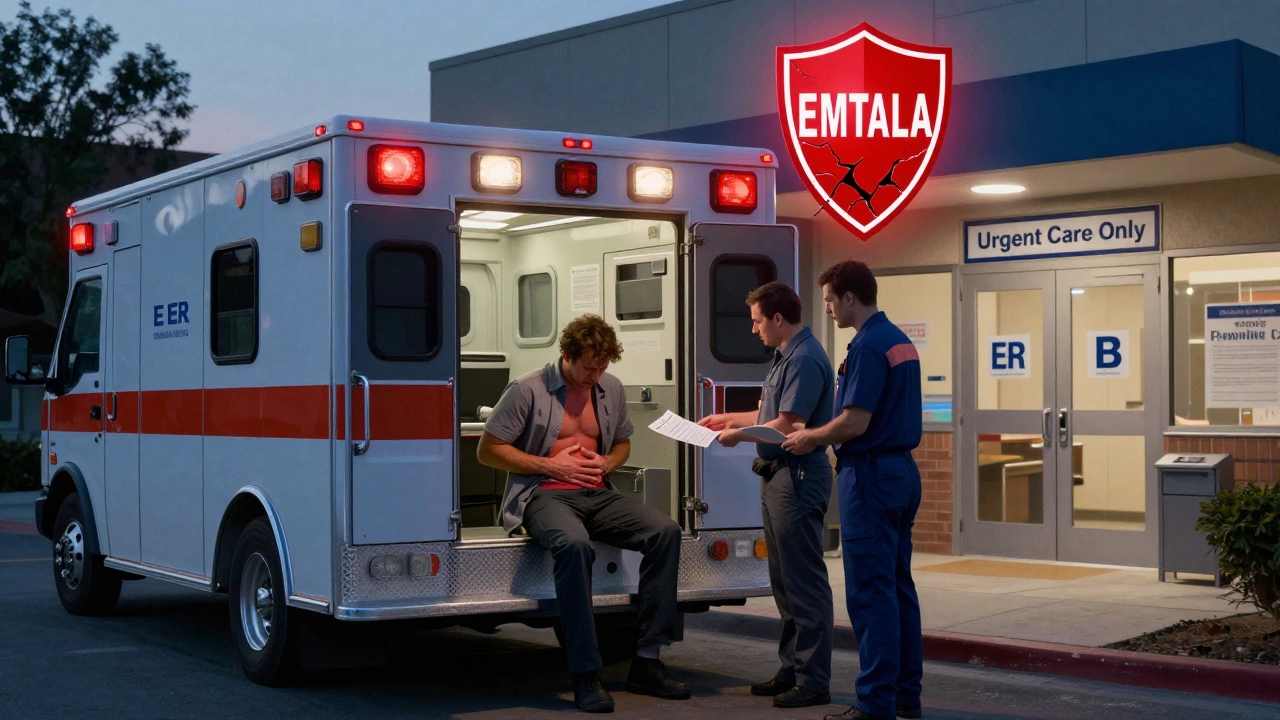
If you believe you were wrongly turned away during an emergency, you have rights. First, ask for the hospital’s patient advocate. They’re required to help you. Second, file a complaint with the Centers for Medicare & Medicaid Services (CMS). They investigate EMTALA violations. Third, contact your state health department. Many have hotlines for patient rights.Keep records. Take photos. Write down names and times. If you were denied care and it led to harm, you may have legal grounds for a lawsuit. There have been cases where hospitals paid millions in settlements after patients died because they were sent away.
The Real Problem: A System Built on Fear
The law says hospitals can’t turn you away. But the culture says: "Don’t go unless you have to." Many people avoid the ER because they’re terrified of the bill. A 2024 survey by the American Journal of Managed Care found that 58% of Americans with chronic conditions delayed emergency care because of cost. That’s not just a financial issue-it’s a public health crisis.People die waiting. A mother with chest pain doesn’t go to the hospital because she’s afraid of the bill. She dies at home. A teenager with a fever doesn’t get checked because his parents lost insurance. He develops meningitis. These aren’t rare cases. They’re predictable.
EMTALA is a shield. But it’s not a sword. It stops hospitals from refusing care, but it doesn’t fix the debt, the fear, or the lack of follow-up. The system works in theory. In practice? It’s a minefield.
Final Reality Check
Can US hospitals turn patients away? In an emergency? No. Legally, they can’t. But if you’re not having a life-or-death crisis? Yes. And even if you are, you’ll likely be left with a bill you can’t pay, a system that doesn’t care, and no real safety net.There’s no easy fix. But knowing your rights helps. If you’re in pain, if you’re bleeding, if you’re in labor-go to the ER. Demand your screening. Don’t let them rush you out. And if you get a bill you can’t afford? Apply for financial aid. Fight it. You’re not alone.
Can a hospital refuse to treat me if I don’t have insurance?
No. Under EMTALA, any hospital that accepts Medicare must provide a medical screening exam to anyone who comes to the emergency department with signs of an emergency medical condition-regardless of insurance, ability to pay, immigration status, or identification. Insurance is not a factor in whether you get care.
What if I go to a private hospital? Are they different?
No. Private hospitals are just as bound by EMTALA as public ones, as long as they accept Medicare-which nearly all do. The ownership structure doesn’t matter. A hospital owned by a for-profit company must still screen and stabilize patients in emergency conditions. The difference is often in how long you wait or how quickly they discharge you after stabilization.
Can a hospital turn me away if I’m not having a heart attack or stroke?
Yes-if your condition doesn’t meet the legal definition of an emergency. EMTALA only protects patients with conditions that could seriously endanger life or health if not treated immediately. A mild headache, a minor rash, or chronic back pain without sudden worsening may not qualify. Hospitals can redirect those patients to urgent care or primary care providers.
Do I have to pay for emergency care even if I can’t afford it?
Yes. EMTALA requires care, not free care. You will receive treatment, but you’ll still receive a bill. However, most hospitals offer financial assistance programs for low-income patients. You must apply for them-don’t assume they’ll automatically reduce your bill. Some states require hospitals to offer charity care; others don’t. Always ask about payment plans or aid before leaving.
What if I’m turned away from an ER and I get worse?
If you believe you were denied care for a true emergency, you have legal options. File a complaint with the Centers for Medicare & Medicaid Services (CMS) or your state health department. Keep records of your visit, including dates, names, and what was said. If you suffered harm as a result, consult a medical malpractice attorney. EMTALA violations can lead to fines and lawsuits against hospitals.